
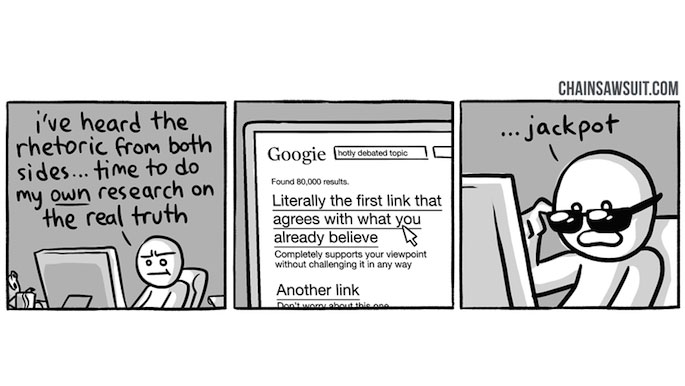
Fake news. Facebook. Social media bubbles. Why do we so often wrap our minds around things we know aren’t true?
The answer is simple: We believe what we want to believe
We actively seek out facts that support our worldview—usually based on our personal experiences and what we hear first. As humans, we’re generally terrible at being objective. And there’s a good reason for that: being objective hurts.
Why Objectivity Feels Uncomfortable
We don’t like having things presented to us that challenge our world view..
This is called confirmation bias. This is when we are presented with multiple examples that challenge what we know, but do not change what we think. We like consistency, so to change our original views challenges how we work.
What our minds helpfully do, is look to confirm what we already know. This is designed to be helpful, as we get so much information we need a way to manage the information flow..
If we don’t have all the facts, we’ll latch onto whatever we hear first, ignoring contradictory evidence.
The Story Is Told By Whoever Speaks First
At a gig last year, the psychologists there explained something that hit me hard. They said if I wanted a project to work, I needed to get in first, so the story was my story.
The line of work I’m in comes with psych support due to its serious nature. Their advice? Simply, get in first. Why? Because people will naturally follow the first version of the story they hear.
It’s like the old saying: hunt or be hunted. Charming, right?
But it’s also disturbingly effective. Whoever sets the narrative first often controls the perception, regardless of whether it’s accurate or not.
Confirmation Bias in Action: Elections and Algorithms
We’ve seen confirmation bias play out on a massive scale.
Manipulation of confirmation bias was also found in elections via social media sites – if you liked a number of posts that are right leaning, you will get advertising that reflects that, and links/click bait that will reinforce what you already know.
Outside of elections, Facebook (and Netflix, and every website that tracks) will make suggestions for you based on past behaviour, thereby reducing the likelihood of you looking outside your confirmation bias.
Breaking Out of the Bias Bubble
So, how do you fight confirmation bias? It’s not easy, but you can try a few things:
1. Disrupt the Algorithm: Like or follow things you wouldn’t normally engage with to break your social media echo chamber. Even better, create a new profile and like the opposite of what you’d usually follow to see what comes up.
2. Consume Different Content: Watch something outside your usual interests. If you usually watch comedies, try a drama. If you love Western films, explore Eastern ones.
3. Learn a New Language: It shifts your perspective and challenges your brain.
4. Take a New Route Home: Literally changing your path can rewire your thinking patterns.
5. Ask for Feedback: Getting input from multiple sources provides a more complete picture.
6. Check Your Sources: Who wrote the article? Who owns the website? Everyone has biases. Acknowledge them.
7. Avoid Pre-Judgments: Don’t listen to gossip before meeting someone. You will try to cling to the the information you got before you met the person. Form your own view.
These little disruptions reroute the neurons in your brain, making them more active and receptive to new information.
Why We Struggle to Let Go of Bias
It is worth noting that confirmation bias is more likely to occur when it is a highly emotional topic for the person, or involves people’s ideology. In other words, we hold tight to what we value, even if it results in choices that make us unhappy.
So to make better choices, and support ourselves into the future, we need to make sure we are looking to hear information that is different to what we already know.
You can never remove bias entirely, but you can tell a more complete picture by looking at the full facts of a story. And you can make better choices, that align with your present and future values and stories, rather than just telling the same old story over and over.
Want to Learn More?
Happy reflection time,
Emma x

Tellus your thoughts!